01
A restaurant you'd travel for?
L'Arpège, Paris.
The GGuide — In Conversation
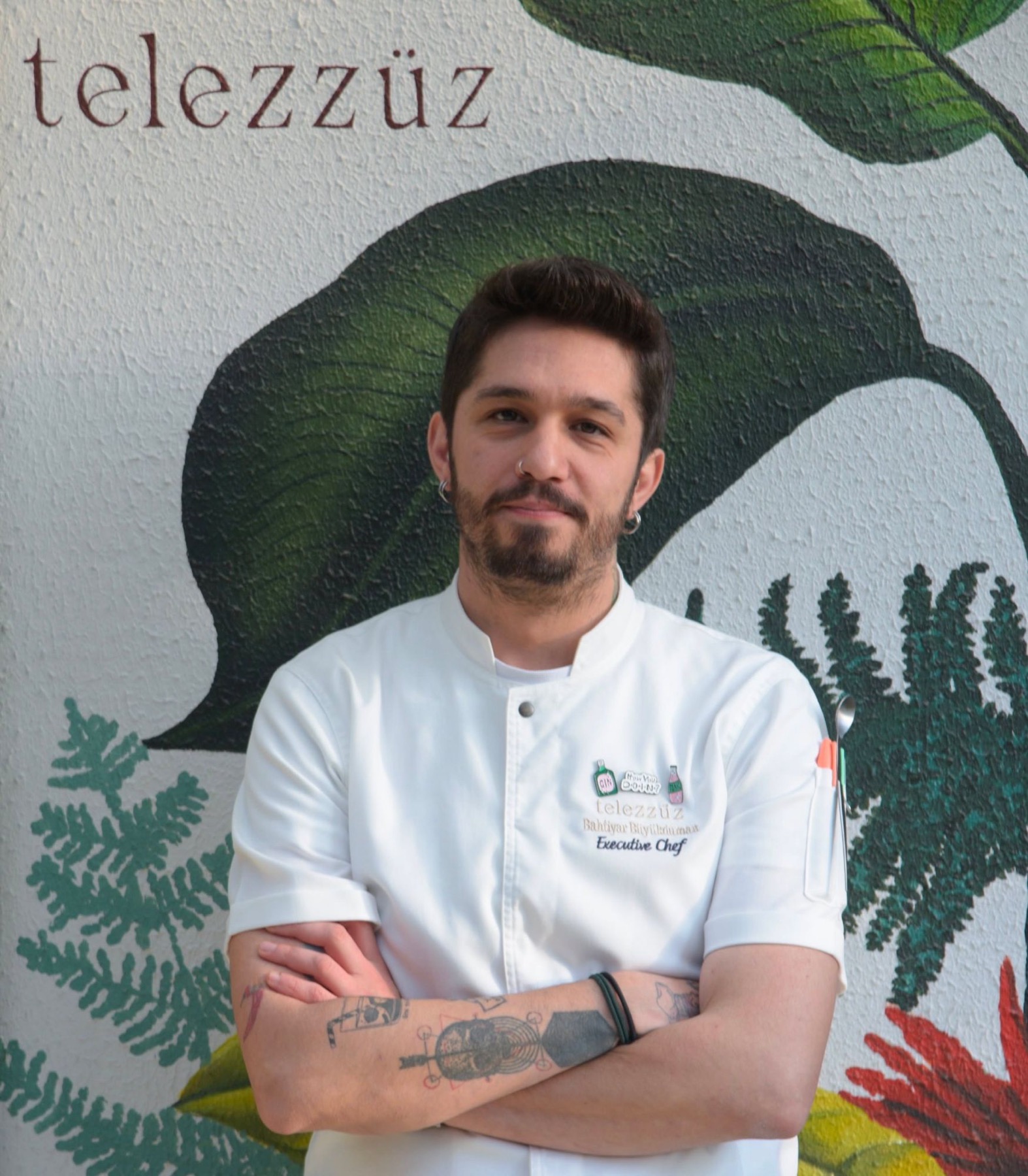
Chef · Telezzüz
The archaeologist turned chef behind Turkey's first vegan fine-dining table — in his own words.
Telezzüz · In Conversation
01
You trained in classical archaeology, but your career took shape in the kitchen. Looking back today, do you think your archaeologist side still influences the way you cook?
Absolutely, I do. The research discipline I learned studying archaeology, and that instinct to get down to the root of things, make up an important part of my kitchen character. When I'm establishing cause and effect, when I'm developing new recipes, I still work like an archaeologist.
02
Throughout your professional life you've worked in many different places — from a kebab shop to a pastry kitchen, from Italian cuisine to hotel kitchens. Is there a past experience, maybe even an unexpected one, whose trace you still see in Bahtiyar Büyükduman's kitchen today?
Outside the kitchen, I worked for a while at a translation office, and for about two years in new-generation coffee businesses. Honestly, working a desk job like a translation office gave me other disciplines. I learned various tracking and working principles there, in an area I'd never planned or even considered in my career.
03
You ate vegetarian for many years, and then moved fully toward plant-based eating and cooking. As a chef, did removing animal products from the kitchen limit you, or did it push you to become more creative?
The general view on this always leans toward limitation, but the truth is nothing like that. When the luxury of taking the easy way out is taken from you, your creativity has no choice but to develop. And if you already have creativity in you, this situation actually turns into a great opportunity. It opens the door to making new, original dishes by combining different perspectives, different approaches and classic techniques with plant-based cooking principles.
04
For me, Telezzüz was my first vegan fine-dining experience, and what surprised me most was that at some point I completely stopped thinking, "I'm eating a vegan menu." Is it a success for you when a guest leaves Telezzüz without remembering the restaurant as "vegan"?
First of all, thank you for your kind words. When we design our menu and our dishes, we don't design them only for people who eat plant-based. In the scenario where we're thinking about appealing to everyone, being able to break the prejudices of people who don't eat plant-based, and sending them off from Telezzüz happy, creates a result that makes us happy. In short — yes, for me, sending omnivores off without them even noticing they ate plant-based food, with the result "we had a beautiful meal," is a success.
05
Turkish cuisine already has a very strong plant-based tradition — from olive-oil dishes to legumes, from herbs to dolma. How much do you draw on this heritage when creating Telezzüz? Could creating a modern plant-based cuisine actually mean returning to our own past?
I can't speak in general terms, but at Telezzüz we definitely draw on our culinary heritage from time to time — sometimes in recipes, sometimes in technical methods. We try to create something original, something that is genuinely ours, by combining our own traditions with modern techniques. We pay a lot of attention to how we use the heritage of our rich cuisine — most often as a starting point for inspiration, and sometimes as it is, with our own contribution added on top.
06
You've said Telezzüz was a project Ömer Koç had long dreamed of, and that your paths crossed over this idea. When his vision and your approach to cooking first met, what was the moment you thought, "yes, we can really do something different here"?
The fact that both of us — even in different art forms — look at art with passion, and have both placed art at the center of our lives, made me think we could do very good things together around a shared vision.
07
Telezzüz received a Michelin Green Star. "Sustainability" is a word used a lot in gastronomy today — sometimes too much. Where do you think the line is between a restaurant that is genuinely sustainable and one that only appears sustainable?
It lies in accurately calculating how real and how feasible what you promise actually is. As you also said, sustainability has recently become something of a marketing buzzword on everyone's lips. But it's becoming more and more important, both for the future of nature and the future of the industry. It matters a great deal that chefs and businesses position these issues not as a sales tool but as a philosophically important building block — and put them into practice with realistic goals and plans.
08
Seasonality and a zero-waste kitchen are important parts of your approach. Does the obligation to use an ingredient as fully as possible increase creativity? Has there ever been a dish that came out of a part that would normally go in the trash, and that surprised even you?
To avoid creating waste, you have to think through many different methods, and come up with ways to take an ingredient as a whole and evaluate each part of it separately. That naturally challenges and develops your creativity. Honestly, this is one of the areas I enjoy working in most, because very surprising results can come out of ingredients you'd never expect. Years ago, a pavé I made from zucchini stems surprised me in exactly this way.
09
You've mentioned sometimes building your new menus around an album, a film, a city, or an idea. What is the process of making a song or a feeling "edible" like for you? Does the story come first, or the ingredient?
There's no fixed formula for this. Every case calls for a different approach. When we built the Shakespeare menu, the plays came first, then the dishes. For the Seven Deadly Sins menu, the themes were clear, but designing the dish that would light the fire of "greed" was harder.
I analyze the work or the emotion I'm dealing with very closely, and create various codes and formulations from that. For the greed dish, for instance, instead of a large, over-filled plate, I turned toward ingredients that could correspond to greed within the realm of "luxury." Or, when designing the Macbeth dish for the Shakespeare menu, rather than the play's broad outline, we chose a more specific moment and worked with the instant of the "moving forest."
10
You've also mentioned dreaming of a small restaurant built around "one chef, five dishes, five cocktails, five songs." If you could open it tomorrow with zero commercial concerns, what would one of the five songs of opening night be?
Let me give you the whole list, though it might not appeal to everyone.
Tool – Lateralus, King Crimson – Starless, Radiohead – Everything In Its Right Place, Earth, Wind & Fire – Fantasy (probably ends up as dessert), Dream Theater – A Change Of Seasons.
11
We've seen Istanbul's gastronomy scene change seriously in recent years. Do you think Istanbul is where it deserves to be today as a gastronomic destination in the world? What's still missing?
I think Istanbul is making its way, step by confident step, among the world's gastronomic destinations, but I still think we have some gaps when it comes to meeting international standards. And if we're asking whether Turkish cuisine is where it deserves to be, I still don't think we are — and I think that's something within our own control. Because while we build our cuisine's marketing around generic products we assume are easy to sell, we don't sufficiently own and polish our real values. Once we start doing that, both Turkish cuisine and Istanbul's gastronomy scene will arrive where they deserve to be.
12
Right now, outside the kitchen, what's exciting you most, or inspiring you most?
Music. =) When I'm looking for inspiration in general, I turn to nature and to music. Music is something passed on to us through the experiences and emotions of the people who created it — I use that often, whether I'm studying people, analyzing emotion, or making sense of my own feelings and turning them into inspiration.
Tell Us Where To Go
Tell us where we should go.
01
A restaurant you'd travel for?
L'Arpège, Paris.
02
An address in Istanbul you wouldn't want too widely known — but would tell GGuide?
It doesn't have to be a restaurant. I genuinely don't have a place like that.
03
Your perfect address for a long lunch?
Bi' Nevi Deli.
04
A destination you think still doesn't get the attention it deserves?
Aşeka.
05
If you had a completely free 48 hours tomorrow, where would you go?
To the Puglia coast, with my wife, to clear our heads.
Quickfire
A few favourites, without overthinking it.