01
What makes you decide to go to a city: a photo, a recommendation, a feeling, or a goal?
A feeling that cannot fully be described — only felt when you arrive in a city. A sense of belonging, warmth, and curiosity.
The GGuide — In Conversation
Visionary · Smarana Healing
Healing, intuition and Smarana — the visionary in her own words.
Smarana · In Conversation
01
Wellness has become a major industry in recent years. Do you think people are truly trying to feel better, or simply trying to look better?
Wellness has become a trend in recent years, and at times this can take it away from its original intention of service, community and care. Like many trends, it can easily become short-term, surface-level, or something to consume and share rather than something to truly practice.
So yes, I think there is a part of wellness today that is connected to how things look from the outside — attending an event, sharing it on social media, identifying with a certain lifestyle. But beneath that surface, I also believe there is a much deeper longing.
For me, real wellness begins where performance ends — in the honest practice of meeting ourselves. It is a lifelong journey of being able to sit with ourselves honestly. It requires discipline, openness and sincerity. It asks us to return to the parts of ourselves we may have forgotten, hidden, or learned to silence.
In that sense, I think wellness today holds both realities: the surface-level trend, and the deeper invitation to remember ourselves. And for me, that invitation is about returning to our essence, our authenticity, and the truth of who we are beneath the layers of protection.
02
When you founded Smarana, were you trying to create a wellness brand, or something entirely different?
When I founded Smarana, my intention was never to create a “wellness” brand. I don’t think I even had the language for what I was trying to create at the time. I only knew that I was searching for something I had been longing for for many years.
Since childhood, I carried this difficult-to-explain feeling of homesickness. Not necessarily for a house, or a country, or a specific place — but for a feeling. I was always looking for somewhere I could finally surrender. Somewhere I didn’t have to perform, adapt, hide or protect myself.
For a long time, I thought that feeling would come from the outside. A different city, a different country, the right relationship, the right environment. But the more I went inward, the more I realized that what I was searching for was not really a place. It was safety.
Not safety as an idea, but safety as something the body can feel. The kind of safety where your shoulders drop without you asking them to. Where your breath becomes deeper. Where you no longer feel like you have to constantly scan the room, explain yourself, or prepare for something to go wrong.
Over time, my body taught me that “home” is not always where we are. Sometimes home is the first moment the body stops defending itself. That became the seed of Smarana.
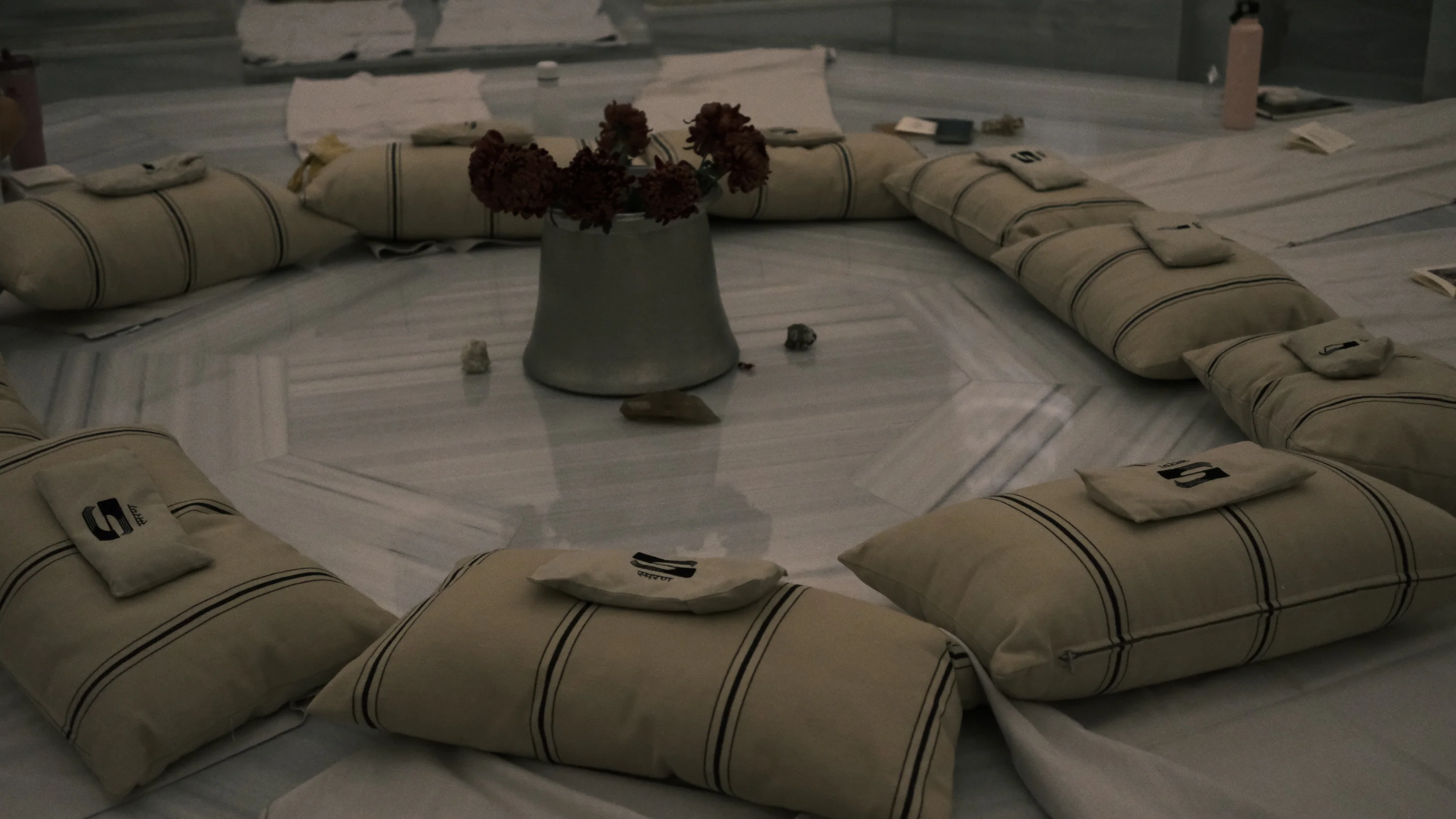
I wanted to create spaces that could offer people even a small glimpse of that feeling. Spaces where the body could soften. Where people could feel held without needing to be fixed. Where breath, sound, silence, scent, beauty and community could all work together to remind the body: you can rest and surrender here.
So yes, we curate experiences. But underneath all of that, the intention is very simple: to create an atmosphere where people can feel supported enough to return to themselves. And I think that kind of remembering often happens in community. Perhaps that is why community has always been at the center of what we do.
03
Breath is one of the most natural things we all do. What turned it into a field of practice for you?
One of the places modern life has distanced us from the most is the body. We are constantly thinking, producing, planning and moving toward the next thing. The mind is always busy, but the body is often quietly carrying everything we have not had time to feel.
For many years, I lived mostly in my mind. I was functioning, creating, moving forward — but underneath it all, my body was often on alert. Today I understand that my nervous system had been living in a chronic state of protection for a long time. Breathwork was one of the first places where that began to change.
What moved me was not only the emotional release, but the intelligence of the body. When the breath becomes slower, deeper and more rhythmic, something begins to shift. Diaphragmatic breathing can support the parasympathetic nervous system — the state connected to rest, digestion and repair. A longer exhale can gently remind the body that it may be safe to soften.
Through breathwork, stored emotions can finally have somewhere to go. The body can hold incomplete emotional cycles — grief that was interrupted, fear that had to be contained, anger that was never expressed. Breathwork can bypass the part of the mind that wants to analyze everything and work more directly with the nervous system.
That is what made breath a field of practice for me. It was never just a technique. It was a doorway into the body, into feeling, into the places where words could not reach. Because so many people do not need more information; they need a space where the body can finally feel safe enough to release, express and just be.
04
A word that often appears at the center of Smarana is “remembering” — remembering oneself. What do you think modern humans have forgotten the most?
I think we have forgotten how to listen before things become loud.
We often wait until the body is exhausted, tense, anxious, numb, in pain, or completely shut down before we finally stop. But the body is usually speaking much earlier than that. In the small contractions. In the way we hold our breath. In the tightness in the jaw. In the quiet feeling of “this is not right for me.” I think we have become very good at overriding ourselves.
We override our hunger, our tiredness, our intuition, our grief, our anger, our need for rest, our need for closeness. And slowly, without realizing it, we lose contact with the parts of us that are more honest.
For me, remembering is much simpler than a mystical idea. It is the moment someone takes a full breath after holding themselves for years. It is the moment the body softens without being forced. It is the moment we realize we do not have to keep performing who we think we should be.
Maybe remembering is just that — returning to the places inside us that we abandoned in order to be accepted, and meeting them again with more tenderness.
05
People are closer to information than ever before. But are they equally close to themselves?
We are closer to information than ever before, yet we seem to be drifting further from ourselves.
Every day, we are surrounded by advice, opinions and ideas about how to live, feel and “improve”. The outside voices are loud, and it becomes harder to notice what is actually happening inside us. I think many of us are not missing information. We are missing contact.
Contact with the body. With the breath. With our felt sense. With the small internal signals we often override — tension, fatigue, resistance, or a clear “yes” or “no” before the mind explains it.
This is where somatic practices can be supportive. They help rebuild interoception: the ability to sense what is happening inside the body. So perhaps the question is not whether we need more information, but whether we can slow down enough to listen to what the body already knows.
06
When did you first realize that breath is a much more powerful tool than people think?
What moves me most is that breath can reach places words often cannot. So much of our lives is spent trying to understand or explain what we feel. But the body does not always communicate through language. It communicates through sensations, sound and movement.
In breathwork, the mind does not have to lead the process. That is what makes it powerful. For me, the exhale is one of the most important parts of the practice. By lengthening the exhale, we can gently send the body the message, “I am safe.” And when the nervous system receives that message, the body often begins to release what it has been holding — in the shoulders, the jaw, the hips, the belly.
I think many emotions stay in the body because they were never fully expressed at the time. Grief that was interrupted. Fear that had to be contained. Breathwork creates conditions for those incomplete emotional cycles to begin moving again.
What I also love is that we slowly begin to uncouple the past from the present. The body starts to learn: this moment is not the same as that moment. I do not have to respond with the same fear and the same protection. For me, breath is a way of giving the body back its own language.
07
What was the silence that transformed you the most in your life?
The silence that transformed me the most was during a retreat in the Sahara Desert in Egypt with the Bedouins. That silence of the desert felt strangely familiar, as if my body had returned to something it had known before but somehow forgotten.
I think that experience changed the way I understood silence. Silence is not loneliness. It is not emptiness either. It is a space where you can begin to witness what you have pushed away, without needing to be afraid of it.
Sometimes we carry so many knots inside that we cannot explain. Thoughts cannot always untangle them. But in silence, when you stop trying to solve everything and simply give those places space, something begins to reveal itself. That is what silence taught me. Sometimes it simply gives enough space for what is inside to unfold on its own.
08
Where do people usually search for peace, and where do they actually find it?
I think most of us look for peace outside ourselves; in the next achievement, the next relationship, the next holiday, the next version of ourselves. We keep thinking, “Once I get there, then I’ll feel at peace.”
But over the years, both in my own life and in the people I’ve worked with, I’ve come to see that peace isn’t something we find. It’s something that naturally appears when the body no longer feels like it has to protect itself.
When we stop bracing. When we take a full breath without realizing it. When the shoulders soften. For me, that’s what peace feels like. Not the absence of challenge, but the absence of constant defence. It’s not somewhere we arrive. It’s something we allow.
09
Do you think the body is always speaking to us, or do we only hear it when we stop?
I think the body is always communicating with us. Actually, not being able to hear the body is the problem. We are born with an instinctive relationship to the body — to hunger, tiredness, fear, desire, intuition. But over time, many of us learn to override those signals.
When we keep suppressing those signals, we start moving against the natural flow of the body. We push through. We ignore. Eventually, the body has to speak louder. That can show up as chronic stress, tension, pain, digestive issues, fatigue, anxiety, or other psychosomatic symptoms — not because the body is working against us, but because it is trying to get our attention.
The body usually starts speaking long before things become loud. So perhaps the question is not whether the body speaks. It is whether we are willing to listen before it has to scream, “Look at me.”
10
What is the relationship between healing and knowing yourself?
I don’t really separate healing from knowing yourself. For me, healing is not about becoming a new person. It is about becoming more honest with what you already know.
Most of us know much more than we allow ourselves to admit. We know when something is too much. We know when a boundary has been crossed. We know when we are tired, angry, afraid, or no longer aligned. But we often push that knowing away in order to continue, to belong, or to keep things comfortable.
So maybe self-knowledge begins when we stop negotiating with what we already know. It is the moment we can admit: this hurts, this is not right for me, this is what I need, this is what I have been avoiding. That kind of honesty is not always easy, but I think it is where real healing begins.
11
Where would you like to see Smarana in ten years?
My deepest intention for Smarana is that it continues to grow in a way that stays true to the feeling it was born from. I dream of growth — reaching more people, more places, more collaborations. But I don’t want it to grow in a way that loses its intimacy. For me, growth only feels meaningful if the essence stays intact.
Wherever we are, we will continue creating spaces where people feel seen, connected, and safe enough to return to themselves.
I would also love to collaborate more with organizations working with children, animals, and deaf and hard-of-hearing communities — groups whose needs are often overlooked. I think safety and belonging are often most needed in the places that receive the least attention.
But honestly, I don’t want Smarana to be remembered for its size. I want it to be remembered for how it made people feel. If someone leaves Smarana feeling a little lighter, a little closer to themselves, and a little freer in their body, then that is success for me.
On Travel
The questions we ask every traveller.
01
What makes you decide to go to a city: a photo, a recommendation, a feeling, or a goal?
A feeling that cannot fully be described — only felt when you arrive in a city. A sense of belonging, warmth, and curiosity.
02
Is there a travel moment that truly touched your life, maybe even changed you?
My solo backpacking trip to Bali in 2014. I was there for two months on my own, and it was one of those trips that quietly changes the direction of your life.
03
Is there a place that crowds have not yet discovered, but you think they should?
Hydra. It is timeless, simple and has a very powerful energy.
Quickfire
The essentials — in a line each.